AISecOps Interceptor governs agentic AI across Security, Compliance, Cost Control, and Observability. It adds plan extraction, capability validation, policy enforcement, runtime budgets, agent identity, replay diff, and compliance evidence export to the execution path.
Enterprises are deploying AI agents that browse the web, read email, query databases, and execute code. Traditional application security was not designed for governed autonomous execution systems with identity, policy, evidence, and cost controls.
Your AI agent calls a tool. You see a log entry. There is no identity layer, policy engine, evidence package, or replay diff to explain what changed, why the action was allowed, or whether it stayed within budget.
Every execution plan passes through a runtime governance platform. Agent identity, capability gates, policy enforcement, runtime budgets, replay diff, and compliance evidence export are all part of the same path. Structured audit logs enable explainability, forensics, and governance.
Indirect prompt injection via RAG. Tool parameter manipulation. Missing identity. Missing evidence export. Uncontrolled runtime cost. Policy drift as models and prompts evolve. These are not theoretical and have been demonstrated in production agentic systems.
A layered runtime governance architecture: plan extraction, local enforcement mode, agent identity, MCP policy proxy, policy enforcement, runtime budgets, replay diff, evidence export, and replayable observability. Open-source reference implementations, enterprise adoption guidance, and threat models aligned to OWASP LLM risks.
AISecOps governs the runtime path from plan extraction to evidence export with security, compliance, cost control, and observability as first-class operating concerns.
Local enforcement mode, agent identity, capability validation, policy enforcement, and MCP policy proxy controls keep execution inside declared runtime boundaries.
Compliance evidence export, structured audit, replay diff review, and explicit governance results create an auditable record for regulated workflows.
Runtime budgets, bounded agent activity, and policy-aware execution tracking keep agent behavior within spending limits.
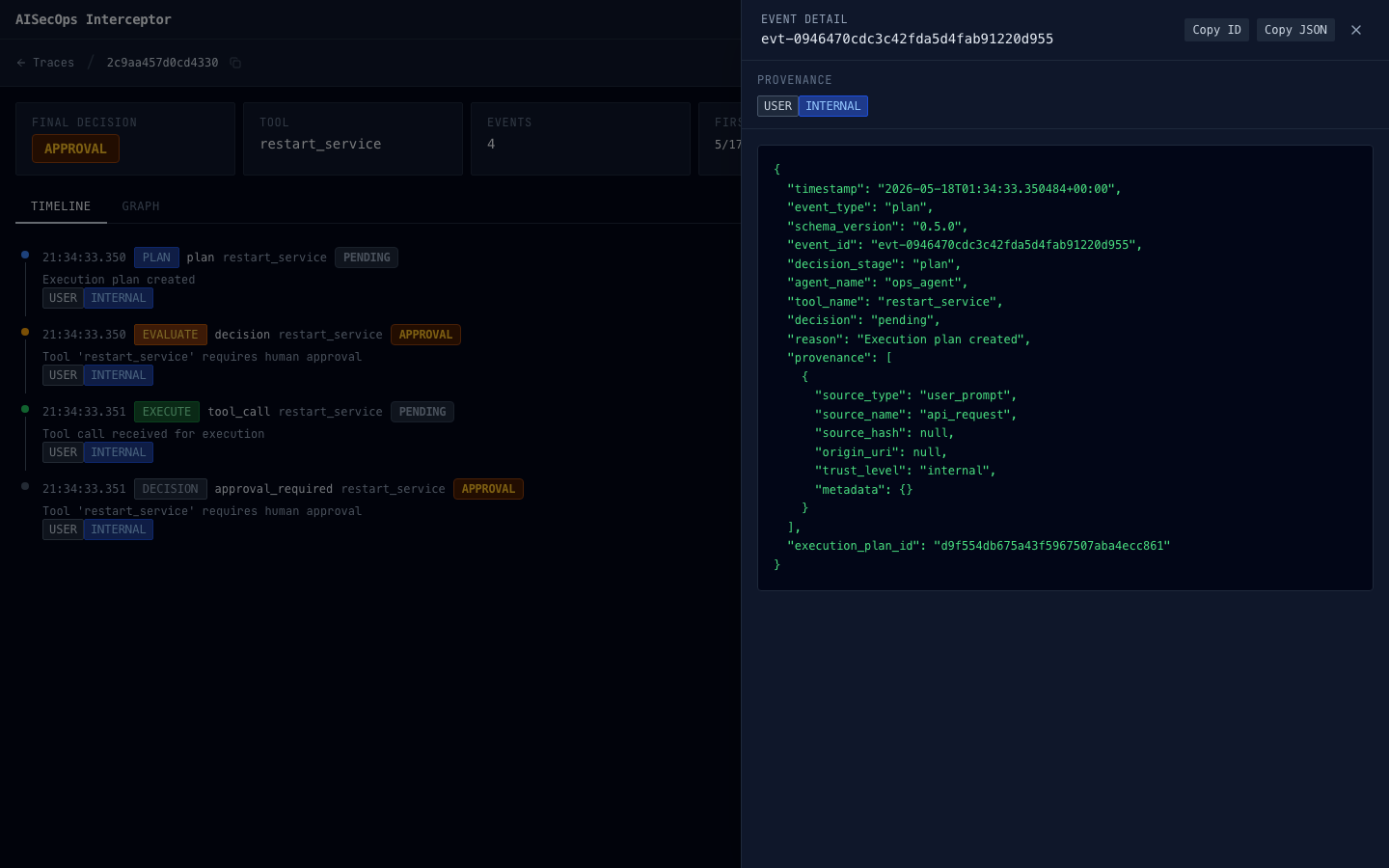
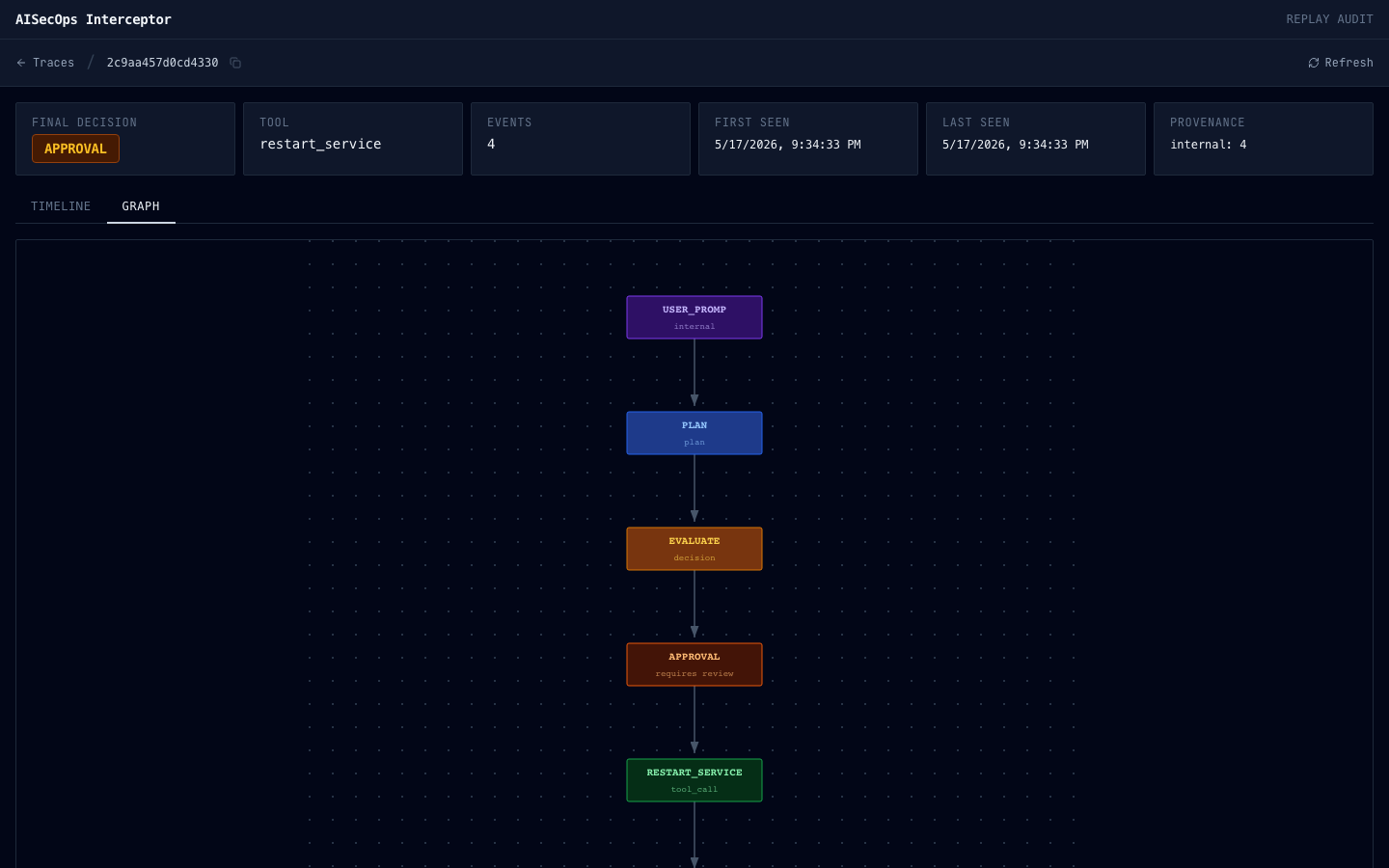
Replay audit UI, execution graphs, replay diff, and risk explanation turn runtime events into operational visibility.
AISecOps reconstructs execution history from structured runtime events: structured plan extraction, capability validation, policy enforcement, runtime budgets, runtime controls, execution, audit, replay diff, and final governance outcomes.
Replay summaries expose runtime decisions, provenance trust levels, event counts, and execution outcomes for forensic investigation.
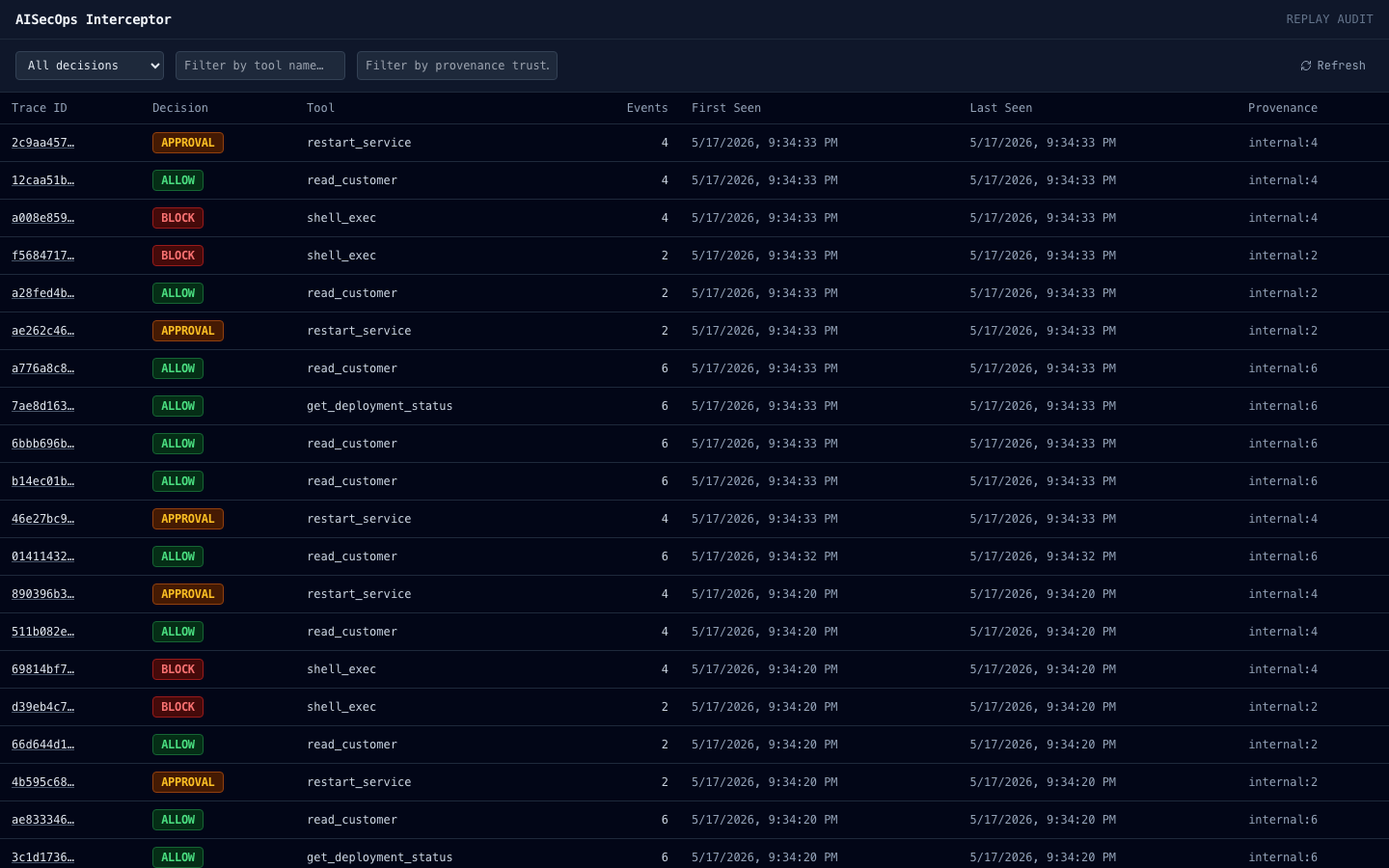
Structured replay timelines reconstruct planning, evaluation, approval, execution, and final governance decisions in execution order.
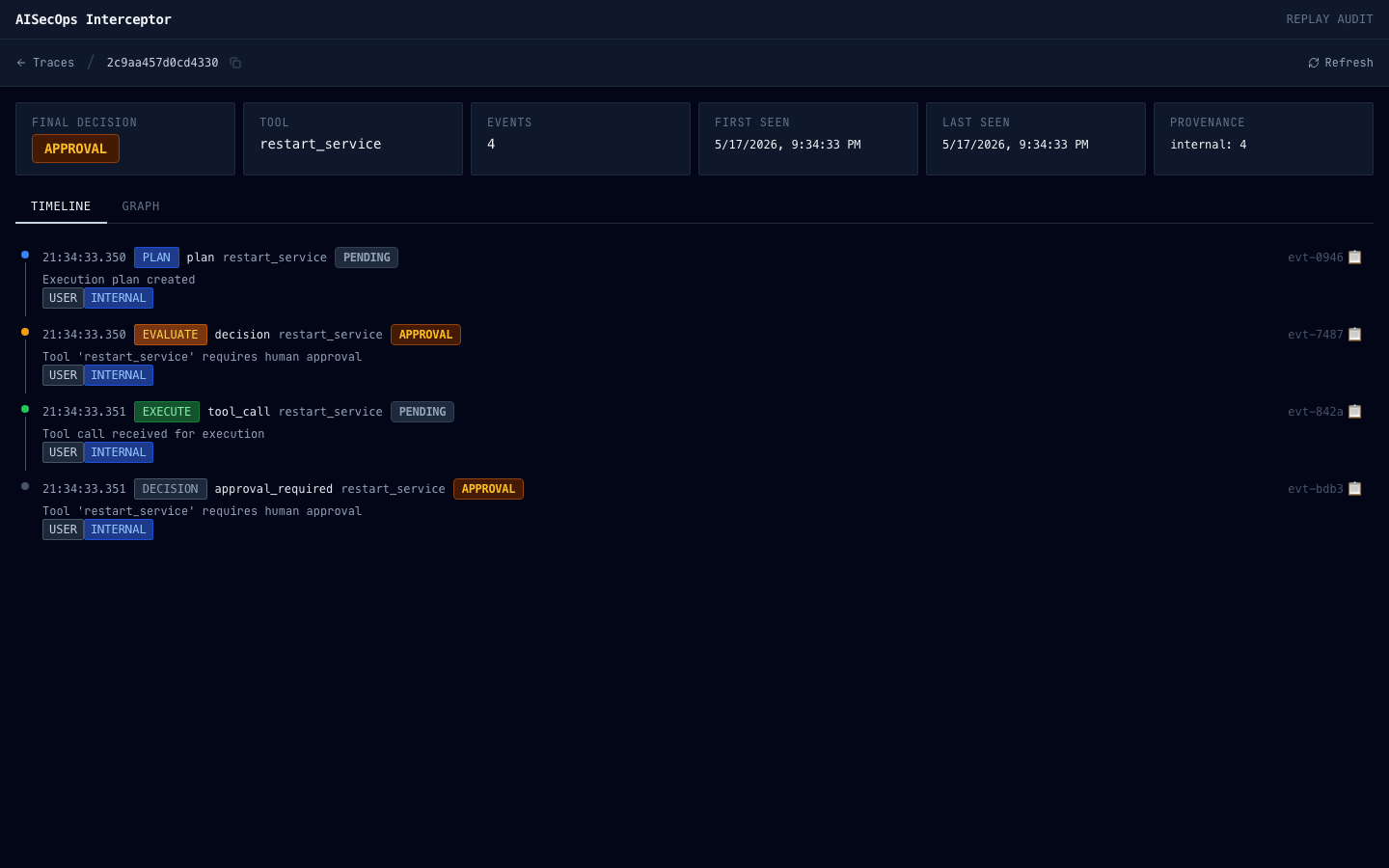
Execution graphs reconstruct causal runtime relationships between provenance sources, planning stages, policy enforcement, approvals, tool execution, and final outcomes.
A deep dive into AISecOps Interceptor, runtime governance, replay diff, evidence export, execution graphs, and why AI agents need a governance layer once they start taking actions.
Read on Medium →
Framework documentation, threat models, reference architecture, and working open-source code. No account required.
The disambiguation page — how AISecOps for agentic AI differs from legacy "AI for SecOps" definitions.
Read the definition →MCP, A2A, swarm systems — a structured threat model covering all major agentic AI attack vectors with OWASP LLM mapping.
View threat model →A runtime governance blueprint: local enforcement mode, agent identity, capability validation, policy enforcement, runtime budgets, replay diff, and evidence export.
View architecture →Runtime investigation workflows for agent identity, replay diff, compliance evidence export, timeline reconstruction, execution graph analysis, and forensic review of AI agent decisions.
View runtime forensics →Framework document covering AISecOps v1.0 foundations, runtime governance, replay diff, evidence export, capability-gated execution, and enterprise adoption guidance.
Download →Reference implementation with Runtime Governance APIs, Replay Diff Engine, Agent Identity Layer, Replay Audit UI, and execution graph investigation.
View on GitHub →